
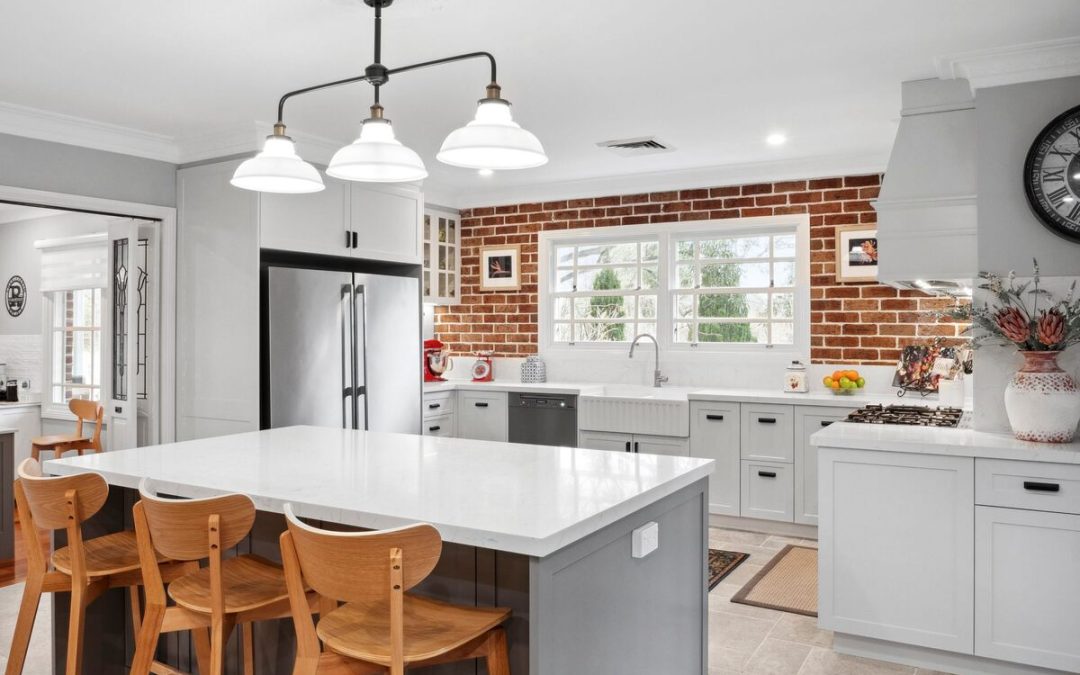
Terrace Joinery | Sydney’s North Shore, Hills District & Hawkesbury
If you’ve started researching kitchen cabinets, you’ve probably already discovered there are two very different worlds out there. On one side, you have modular and flat-pack options – affordable, widely available, and ready to go. On the other, you have custom kitchen cabinets – made to measure, built to last, and designed entirely around your home and your life.
At Terrace Joinery, we’re a Sydney family business and we’ve been building custom kitchen cabinets for homeowners across the North Shore, Hills District, and Hawkesbury for years. We hear the same questions again and again – and they’re good ones. Here’s everything you need to know before making one of the most important decisions in your home renovation.
What Exactly Are Custom Kitchen Cabinets?
Custom kitchen cabinets are cabinetry built from scratch to your exact specifications – your dimensions, your layout, your material choices, and your storage requirements. Nothing is pulled off a shelf or ordered from a catalogue.
Every cabinet is:
- Made to measure for your specific space
- Built using materials chosen for your kitchen’s conditions
- Designed around how you actually use your kitchen
- Finished to match your aesthetic – colour, texture, handle style, and edge profile all your choice
This is the fundamental difference between custom and modular. With modular cabinets, your kitchen is designed around a fixed set of sizes and options. With custom, the cabinetry is designed around you.
Why Do Custom Cabinets Last Longer Than Modular Options?
This is one of the most important things to understand before you buy – and it comes down to materials and construction.
Most flat-pack and modular cabinets are built using standard particleboard. It’s a perfectly functional material in dry conditions, but kitchens are not dry environments. Steam from cooking, condensation, splashes near the sink, and humidity all take a toll on particleboard over time. Once moisture gets in, the board swells, the joints weaken, and the cabinet begins to fail.
Custom kitchen cabinets are different because:
- Moisture-resistant board is used as standard – specifically engineered to handle the humidity and occasional splashes that kitchens produce. It won’t swell or degrade the way standard particleboard does
- Joinery is stronger – custom cabinets are built with proper cabinet-making techniques, not clip-together flat-pack assembly
- Hardware is higher quality – soft-close hinges, drawer runners, and internal fittings from quality suppliers perform better and last longer
- Thickness matters – custom cabinetry is typically built with thicker board than modular alternatives, which adds rigidity and longevity
The result is a kitchen that looks and functions just as well in 15 years as it does on day one. We regularly work in homes where our clients are upgrading from a flat-pack kitchen that’s only 8 to 10 years old. A well-built custom kitchen should comfortably last many many more years.
What Materials Are Used in Custom Kitchen Cabinets?
Understanding the materials helps you ask the right questions when getting quotes. Here’s a plain-English breakdown:
Cabinet carcass (the box itself):
- Moisture-resistant MDF or particleboard – the workhorse of quality kitchen cabinetry. Dimensionally stable and resistant to humidity
- Plywood – premium option, even stronger and lighter than MDF. Often used in high-end or architecturally designed kitchens
Cabinet doors and drawer fronts:
- Polyurethane – a smooth painted finish applied over MDF. Durable, easy to clean, available in any colour. The most popular choice in Sydney kitchens right now
- Timber veneer – real wood grain over an engineered substrate. Warm, natural, and increasingly popular as homeowners move away from stark white kitchens
- Laminate – modern laminate has come a long way. Available in a huge range of textures and finishes including timber looks, matte surfaces, and concrete effects
- Two-pac paint – a spray-applied finish that gives an extremely smooth, hard-wearing surface
Benchtops:
- Stone – engineered quartz or natural stone. Durable and timeless
- Timber – warm and characterful, requires more maintenance but adds extraordinary beauty
- Porcelain – an increasingly popular alternative to stone, very hard-wearing and available in large format slabs
At Terrace Joinery we’ll guide you through the right material for your kitchen, your lifestyle, and your budget – not just what looks good in a showroom.
What’s the Difference Between a Cabinet Maker and a Kitchen Company?
This is worth understanding before you start getting quotes.
A large kitchen company typically works from a set range of door styles, colours, and cabinet sizes. Their designers work within that system – which means your kitchen is designed around their product, not your home.
A cabinet maker like Terrace Joinery starts with a blank page:
- We measure your space precisely and design around it
- We’re not limited to a catalogue of sizes – if your ceiling is an unusual height or your walls aren’t perfectly square, we work with that
- We build everything ourselves, which means full quality control from start to finish
- You deal with the same family team from design through to installation – no handoffs between departments
The personal relationship matters more than most people expect. When you’re making decisions about something as central to your home as your kitchen, having someone who knows your project inside out makes the whole process far less stressful.
How Do I Choose the Right Cabinet Style for My Home?
The best kitchen cabinets are ones that feel like they belong – not like they were installed in the wrong house. Here’s how to think about it:
- Match your home’s character – a Federation or heritage home often suits timber tones and shaker-style doors. A contemporary new build suits flat-panel doors and integrated handles
- Think about your living spaces – in open-plan homes, your kitchen is visible from the lounge and dining room. It needs to work as part of the whole, not just on its own
- Consider the light – north-facing kitchens can handle darker tones. South-facing kitchens often benefit from lighter cabinets to compensate for less natural light
- Don’t just follow trends – trends are useful inspiration, but a kitchen built around a passing trend can feel dated quickly. Build around your taste and your home first
- Think long term – you’re likely living with this kitchen for 15 to 20 years. Choose something you’ll love at year 10, not just on installation day
What Storage Features Should I Ask For?
This is where the real value of custom cabinetry shows up day to day. Good storage design makes your kitchen a pleasure to use. Here’s what we recommend considering:
- Deep drawer stacks instead of lower shelf cabinets – dramatically more practical for pots, pans, and bulky items
- Full height pantry cabinets with internal pull-out drawers – everything visible and accessible without crouching
- Integrated bin drawers – hide your bins behind a cabinet front that matches the rest of the kitchen
- Appliance garage – a dedicated section that closes over your benchtop appliances, keeping the kitchen looking clean
- Corner solutions – pull-out corner drawers that actually make use of those awkward corner cabinets
- Drawer inserts – custom-fitted cutlery trays, knife blocks, and spice organisers built into the drawers themselves
The right storage design is very personal – it depends entirely on how you cook, how many people use the kitchen, and what you need to store. This is a conversation we love having with clients because the difference a well-thought-out storage plan makes to daily life is remarkable.
How Long Does It Take to Get Custom Kitchen Cabinets Made?
Here’s a realistic timeline for a custom kitchen cabinet project:
- Initial consultation and measure – 1 to 2 weeks to get the first meeting scheduled and complete the measure
- Design and drawings – 1 to 3 weeks depending on complexity
- Material selection and approval – 1 to 2 weeks
- Production – 4 to 8 weeks for cabinets to be built in our workshop
- Installation – 3 to 7 days on site
Plan for 10 to 16 weeks in total from first contact to completed kitchen. The earlier you start the process, the more relaxed the decision-making – and the better the result.
Are Custom Kitchen Cabinets Worth the Investment?
For a family home in Sydney – almost always yes. Here’s why:
- They last significantly longer than modular alternatives – often 20 to 30 years vs 8 to 12
- They add genuine value to your property – a well-designed custom kitchen is one of the strongest returns on renovation investment
- They’re built for your space – no awkward gaps, no wasted corners, no compromises
- They reflect your home’s character – not a catalogue
And practically speaking, when you factor in the cost of replacing a flat-pack kitchen every 10 years versus a custom kitchen that lasts 25, the long-term economics often favour custom more than people expect.
Ready to Talk About Your Kitchen Cabinets?
If you’re planning a kitchen renovation on Sydney’s North Shore, in the Hills District, or across the Hawkesbury region, we’d love to talk through your project. Every Terrace Joinery kitchen starts with a free measure and quote – no pressure, just a proper conversation about your space and what’s possible.
You can also explore our full range of residential joinery – including bathroom vanities, laundries, and home offices – on our residential page at terracejoinery.com.au/residential/
Get in touch today and let’s start designing something your family will love.
👉 Request a Free Measure & Quote
Terrace Joinery | Custom Kitchen Cabinets & Joinery | Sydney North Shore, Hills District & Hawkesbury Australian-made cabinetry | Family business | Free measure and quote